Posts Tagged ‘projects’

Illuminated, Interactive ‘Skirt Full of Stars’ – Part 2

Thursday, February 25th, 2010

Update: A tutorial with instructions to make your own Skirt Full of Stars is now posted at StarSkirt.PolymathDesignLab.com

Now you can see the Skirt Full of Stars in action!

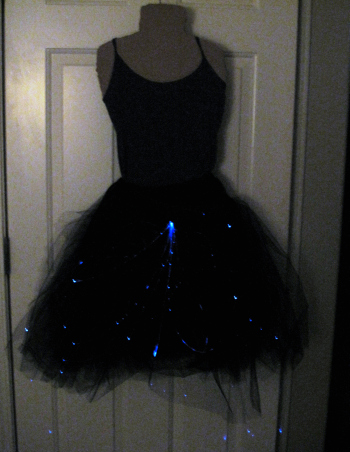
In case you haven’t seen my last post about it, this is a hand-sewn tulle wrap skirt with integrated fiber optics and lights that change color in response to the speed and direction of the wearer’s movement.

It uses the Lilypad Arduino platform, developed for integrating electronics into textiles. There’s a purple organza underlayer to the skirt onto which is sewn the Lilypad main circuit board and a power supply, and an accelerometer hangs from a ribbon to allow for freedom of movement. The Lilypad receives the measurements of the accelerometer’s movement, and translates them into color output for the tricolor LEDs around the waistband of the skirt.

I used sparkle fiber optic cable to cut the harsh quality that you can get when using LEDs and distribute the light more evenly throughout the skirt. In previous prototypes I had simply created a line of LEDs swirling around the skirt, and this makes for a far more subtle and wearable effect.

I have to say, getting decent video of this skirt was quite a challenge! Too much light and the fiber optics didn’t show up on camera, too little and nothing showed up at all. Even this isn’t an accurate representation of what it looks like in person – the camera mostly just picks up the points of light from fiber optics pointed directly at it, where in person you can see them all around the skirt. But hopefully it at least gives a decent idea of how the whole thing works…

Want your own?

It looks like I’ll be making another of these soon, so I plan to take more photos of the construction process and post the instructions here as I go.

If you’re not feeling the yearning to jump into making wearable electronics yourself but you still want your own, send me an email at shannon@polymathdesignlab.com. I had a lot of fun creating this and would be thrilled to make some as custom projects.
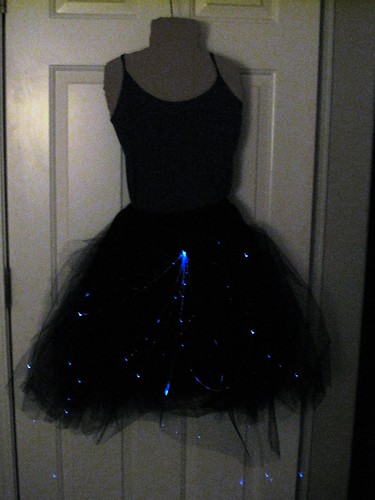

Skirt full of stars

Bookmark and Share

Illuminated, Interactive ‘Skirt Full of Stars’ – Part 1

Friday, February 12th, 2010

Skirt full of stars - in lightSkirt full of stars - in half dark

Hooray, Hooray – it’s finally done!

Introducing my ‘Skirt Full of Stars’ – an interactive, illuminated skirt using the Lilypad Arduino – a microcontroller board designed for textile use.  The skirt incorporates an accelerometer to measure the wearer’s movement, and the ’stars’ change color based on that movement.

I’ve been working on this skirt for around a year now – you may remember the video I posted last spring of my proof of concept circuit. In the time since then I’ve created two other prototype skirts, which were great steps in my learning but didn’t end up working quite as I’d hoped. This one, however, made it though a full real-world test wear at last week’s Bassnectar concert with flying, or at least dancing, colors.

Here’s what that circuit from the video ended up turning into:

Skirt Full of Stars - the circuit

And here it is showing a different color as I move the accelerometer:

Skirt Full of Stars - circuit with motion

I sewed the circuit into a handmade tulle wrap skirt, then attached fiber optics to each of the LEDs and wove them through the lower layer of tulle.

I’m hoping to get some better pictures and some video of it this weekend, so stay tuned for more details.

Bookmark and Share

Kitchen Experimentation: Curried Peanut Butter Chocolates

Monday, February 1st, 2010

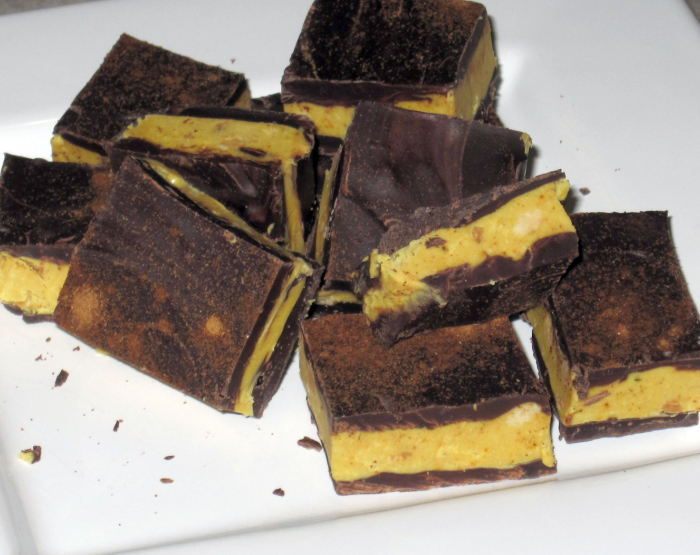
Curried Peanut Butter Chocolates - Yum!

Last fall, Sean and I received a jar of P.B. Loco Curry Peanut Butter from my mom, who was right on in thinking that it was very much up our alley.

After we’d shared a couple of delicious snacks of curry peanut butter with apple slices, I was struck by a grocery-store inspiration! I saw chocolate chips on the shelf and decided to give some candy making a try. After all, peanut butter and chocolate is an old stand-by, the curry peanut butter was tasty, and I’ve had the good fortune to have tried a couple of really good curry-chocolate combinations, so why not put all three together?

I brought home a couple of bags of the white and dark chocolate chips, and got to experimenting. I used a little over half the jar of our curry peanut butter on the first batch, and they turned out great! Got a few odd looks when offering them to friends, but most people were willing to give it a try – and just about everyone who tried them liked them.

But the only P.B. Loco store that I’m aware of is in a mall in Scottsdale, and I’m in Portland. And we wanted to make more – without asking my mom to go to the mall and mail us more peanut butter. So it was back to the kitchen to work out a recipe using only ingredients I could find in my local grocery store. Fortunately, it only took a few tries to get it right – and I can’t say it was a hardship for Sean and I to eat the mistakes.

This final version ended up pretty much just as I was hoping – rich and smooth and just a touch spicy, with some nice texture from the peanut bits and a good balance of flavors that leaves a great taste in your mouth after eating them. Without further ado, here’s the recipe!

Ingredients:

1.5 12-oz bags dark chocolate chips*
1     12-oz bag white chocolate chips*
3/4 cup crunchy peanut butter
1.5 Tbsp curry powder
Cinnamon for dusting

Rectangular cake pan or other deep-sided pan
2 Microwave safe bowls (one for dark chocolate, one for white chocolate mixture)

*Chocolate chips are ideal because they don’t need to be tempered. If you want to try this with chocolate bars, melting wafers, or some other initial form of chocolate, you’ll need to temper the chocolate to make sure it solidifies well and doesn’t end up covered quickly with powdery white bloom. More on how and why to temper chocolate here.

Curried Peanut Butter Chocolates - ingredients (except cinnamon)

Melting chocolate in a microwave:

I used a microwave for chocolate melting instead of a double boiler because it’s quite a bit faster, and you don’t have to worry about accidentally getting water in the chocolate and making it seize. Here’s the basic procedure:

  1. Empty your chocolate chips into a microwave safe bowl – I actually used a glass measuring cup.
  2. Microwave for 30 seconds on 50% power. Remove and stir as best you can – the chocolate will likely still be pretty solid at this point.
  3. Microwave another 30 seconds on 50% power, then stir again. Repeat until the chocolate is smoothly melted. Make sure you are actually pulling the chocolate out and stirring at each interval – the stirring is very important, as it spreads the heat throughout and allows more of the chocolate to melt at each step. If you don’t stop and stir, you could end up burning your chocolate before you think it’s melted. Also note that different types of chocolate will melt differently – the white chips, for example, not only melt faster than the dark chocolate but also to a more liquid consistency.

Dark chocolate - melted

Making the candy:

  1. Line  pan with aluminum foil.
  2. Melt 3/4 bag of dark chocolate chips.
  3. Pour the melted chocolate into pan and spread evenly across the bottom. Shake the pan gently a few times to help the layer even out.
  4. Place pan with chocolate layer into the refrigerator for 2-5 minutes (optional, allows for easier spreading of the next layer, but may increase the likelihood of layers splitting later on.)
  5. Melt 1 bag of white chocolate chips.
  6. Mix peanut butter and curry powder into melted white chocolate until evenly distributed.
  7. Pour the peanut butter mixture into pan and spread evenly over the bottom chocolate layer. Shake the pan gently again.
  8. Place pan back into refrigerator for 2-5 minutes
  9. Melt remaining dark chocolate chips
  10. Pour melted chocolate into pan and spread evenly. Shake pan gently again.
  11. Dust with cinnamon
  12. Place pan into refrigerator to cool. Once cooled and solidified, remove candy from the pan, peel off the aluminum foil, and slice into bite-sized pieces. I found that a pizza cutter  worked really well to cut through the dense chocolate.

Store in refrigerator, or in freezer and allow to warm before serving. Makes lots – be ready to share!

Curried Peanut Butter and Chocolate Delights - Cutting

Bookmark and Share

What a weekend!

Wednesday, May 13th, 2009

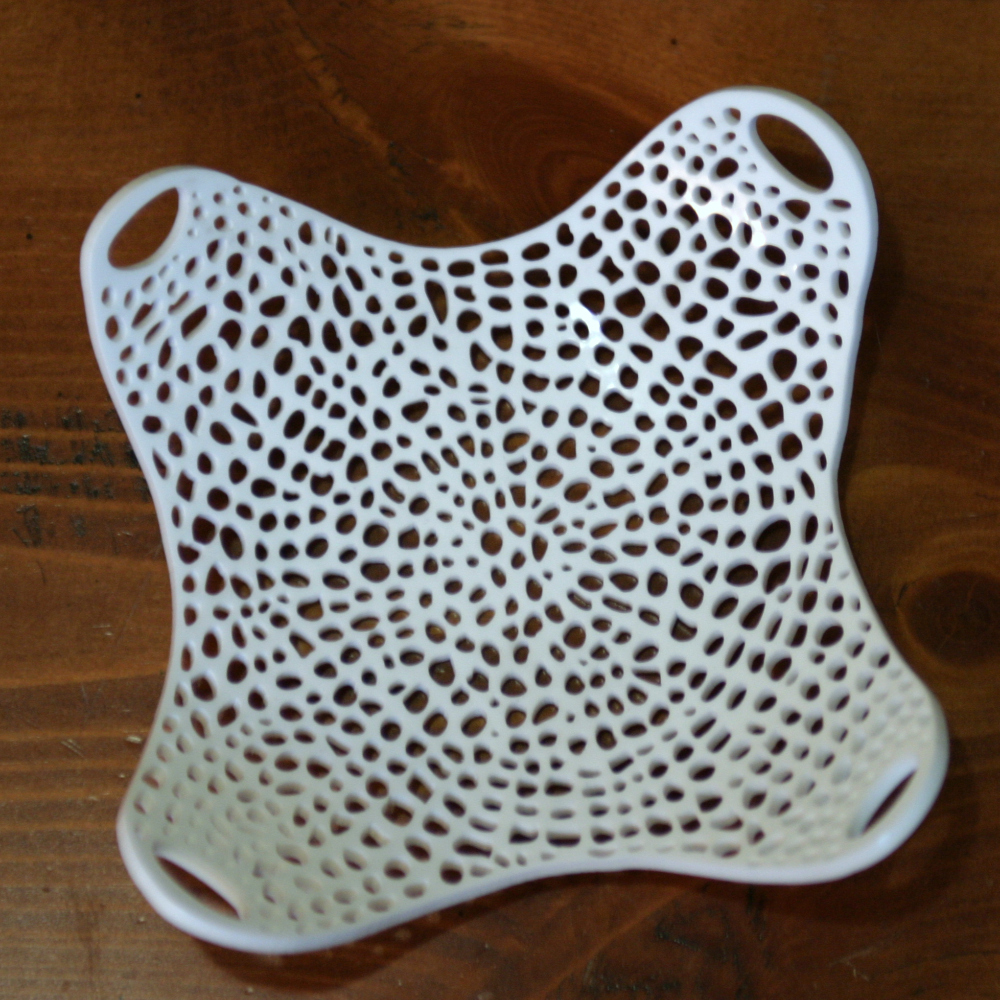
Diatom bowlIt was quite a busy couple of days at Chez Polymath. We kicked things off with a WOMP at the Bassnectar concert at the Crystal Ballroom on Friday night. Can I just say that the Crystal’s floating floor is a lot of fun in a giant crowd of people bouncing and dancing their butts off? Actually, I can do just slightly better than that… here’s a very short video that includes some footage of the show. In fact, if you look closely you can even see Sean and I in the Portland segment!

I finished sewing everything together on the motion-responsive light-up skirt an hour or two before the concert started. Turns out that this particular iteration has some bugs – the first LED lights up SUPER-BRIGHT while the rest go between being either dim or off entirely. I was having trouble with the conductive thread shorting right at the LEDs (the leads are very close together) and with the level of resistance I was getting from the thread, so I actually set the skirt I had been working on aside and made another using ribbon cable (gained by cutting up an old floppy-drive cable) to make the connections. I think that this caused the problems… there were some issues with the stability of the conductive-thread-to-ribbon-cable connection (since I still used the conductive thread between the various boards and between the board and first LED), and not enough resistance in the re-done version. However, it worked well enough for me to wear, and I had a lot of fun with it. I consider this one to be a proof of concept, and will be refining from here. I just ordered a handful of the actual lilypad RGB LEDs to see if the connection placement works better for me than it did on the standard RGB LEDs I have been working with.

Saturday mostly consisted of sleeping in and getting all of the finishing touches done for Crafty Wonderland on Sunday. Even with the time I took off work last week to get ready I hadn’t gotten my sign done, so I changed the plans for that too. I had been planning to use the laser to cut my logo out of some fabric with fusible (iron-on) backing, and then apply it to another piece of fabric, but that seems a bit complex for a last minute thing – especially dealing with getting everything lined up right, so I ended up just printing it on 11×17 paper at Kinkos and backing it with some larger black mat board, and it looked fab. Wouldn’t hold up for anything outdoors, but it was great for an inside show. And now I’m thinking that I may actually try Spoonflower (the print on demand fabric service) when the time comes to put together a more permanent and outdoor-friendly booth sign.

Crafty Wonderland on Sunday was a lot of fun.  I meant to get pictures of my table and displays, but sadly I kept forgetting until highly inconvenient times, so that will have to wait for the next show. Anyway, everyone was very friendly and I got a lot of really great response to both my items and my displays. I ended up in a booth between Barbara of B. Hive Designs and Cate of Bee’s Knees Industries, both of whom were great neighbors. I even ended up trading with Barbara for a gorgeous new shirt, lucky me! And, it looks like I’ll have some more news to share soon that came out of Crafty Wonderland, but I don’t want to say anything until everything’s finalized, so you’ll just have to sit tight on that one until next week.

Oh, and I wanted to mention the photo on this entry – it’s one of my new set of laser cut acrylic bowls, heat formed by hand – this one is based on one form of diatom, a type of tiny algae with intricate, porous silicate cell walls.  It was my entry into the Mad Scientists of Etsy April challenge (theme: Cretaceous) because diatoms first appear in the fossil record when the developed their characteristic cell walls in the early Cretaceous period. MSOE is now running a contest for each monthly challenge, and I’d love if you’d stop by the blog and vote for my entry! Of course, you can also buy the bowl – available through both Etsy and Ponoko.

Bookmark and Share

The prototype video

Monday, March 16th, 2009

I made it over to have my sister take some video of the functioning circuit prototype tonight:


Lilypad Arduino prototype circuit from Shannon Henry on Vimeo.

(for more about what you are watching, see:  A working prototype!)

Bookmark and Share